
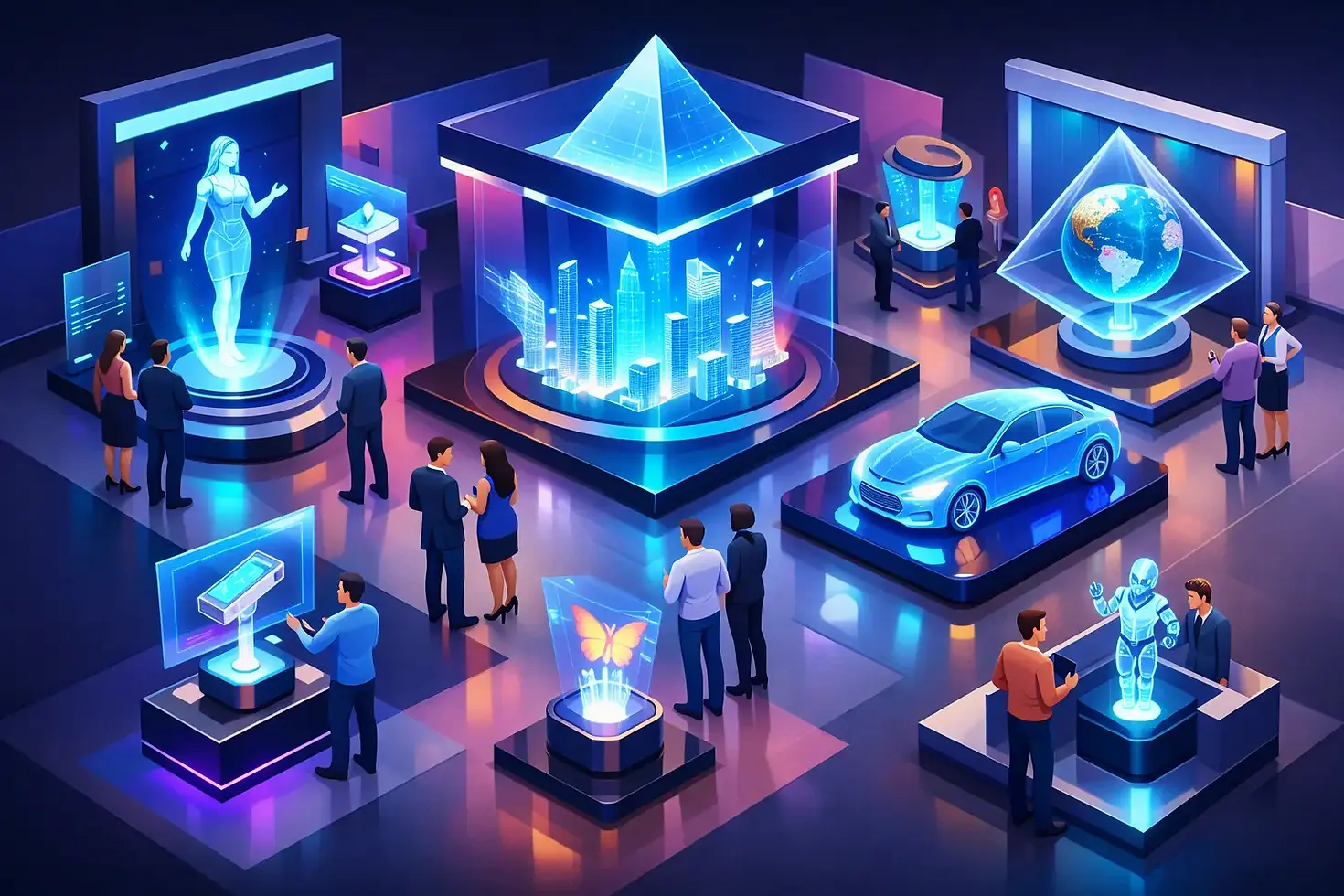
11 Trade Show Hologram Booth Ideas

Trade show floors are loud, crowded, and full of brands trying to say the same thing at once. The best trade show hologram booth ideas cut through that noise fast, turning a quick glance into a stop, a stop into a conversation, and a conversation into a real lead.
Holograms work because they do two jobs at the same time. They pull people in visually, and they give your team a more dynamic way to tell a story. That matters whether you are launching a product, introducing a service, or simply trying to make your booth feel worth walking into.
What makes trade show hologram booth ideas actually work
A hologram display is not the idea by itself. The real idea is how the display supports your goal. If your team wants badge scans, your concept should create curiosity quickly. If your goal is product education, the hologram should explain something people cannot grasp from a banner alone. If the event is about brand positioning, the experience should feel polished enough to match a premium image.
That is where many booths miss the mark. They rent flashy tech, loop random visuals, and hope attention turns into results. Sometimes it does, but not consistently. The strongest concepts tie the visual moment to a clear message, a booth flow, and a reason for the attendee to stay another 30 seconds.
11 trade show hologram booth ideas worth using
1. A floating product reveal
If you are launching something new, let the product appear in midair before attendees ever touch a sample or watch a demo. This works especially well for consumer electronics, beauty products, packaging concepts, medical devices, and automotive components.
The appeal is simple. A floating reveal creates instant drama without requiring a giant physical set. It also gives you more control over how the product is introduced. You can highlight features, rotate the item, zoom into details, and show variants that may not fit on-site.
2. A holographic spokesperson loop
Not every booth has enough staff to deliver the same polished intro all day. A holographic presenter can greet visitors, explain your offer, and direct them to the next step before your team takes over.
This is especially useful when your message needs consistency. It can also help if your booth gets traffic spikes and your staff is already busy. The trade-off is that the script needs to be sharp. If it feels too long or too generic, people will move on.
3. A before-and-after transformation display
Some products are easier to sell when people can see the change they create. Home improvement brands, fitness companies, software providers, industrial manufacturers, and healthcare businesses can all use this format.
A hologram can show the old state, transition into the improved state, and make the value obvious in seconds. That is far more memorable than trying to explain the difference with a printed graphic wall.
4. A scaled-up 3D explainer
If your product is small, internal, or hard to understand, enlarge it. A holographic display can turn a tiny part, system process, or hidden component into a visual centerpiece.
This is one of the smartest trade show hologram booth ideas for B2B exhibitors. Buyers often need clarity more than spectacle. Showing how machinery works, how a product assembles, or how data flows through a platform can shorten the path to a serious conversation.
5. A branded motion wall for nonstop foot traffic
A larger holographic installation, such as a Holowall-style presentation, can create a moving branded backdrop that feels alive instead of static. This works well when your booth is placed on a main aisle and needs to attract attention from several directions.
The benefit here is scale. The risk is clutter. If too many visual elements compete at once, people may notice the motion but miss the message. Keep the creative bold, clean, and centered on one idea.
6. A hologram-powered product comparison
If you are in a category where buyers are weighing options, show the difference visually. Instead of saying your version is faster, lighter, safer, or more efficient, animate the comparison.
This concept works well for equipment, software, packaging, consumer goods, and devices with feature advantages that are hard to explain in one sentence. Just make sure the comparison is credible and easy to absorb. Trade show attendees do not stand still for long.
7. An interactive social share moment
Some brands need foot traffic. Others need amplification beyond the event itself. A holographic photo or video moment can do both if the setup is designed for sharing.
That could mean a branded holographic backdrop, a personalized animated element, or a short immersive moment that makes attendees want to film it. The trick is not to chase novelty for its own sake. The shareable moment should still look like your brand, not like a random effect people cannot connect back to you.
8. A timed mini-show every 10 minutes
Instead of running passive content all day, create a short recurring presentation. A two-minute holographic sequence can announce itself, gather a crowd, and give your sales team a natural opening.
This format works because it creates momentum. People are more likely to stop when they sense something is about to happen. It also helps your team manage traffic in waves rather than trying to pitch every passerby individually.
9. A hologram catalog for multiple SKUs
If your company sells many products, bringing everything to the show is expensive and impractical. A hologram can display a broader product range without crowding the booth.
This approach is useful for distributors, manufacturers, and retailers with lots of variations in color, size, or configuration. It keeps the space clean while still showing breadth. The key is organization. If the visuals feel random, the audience will not know what to focus on.
10. A founder or expert message that feels premium
For brands that want stronger authority, a holographic message from a founder, executive, designer, or subject matter expert can elevate the booth. It gives the brand a polished, forward-looking feel without requiring that person to stand there all day.
This is most effective when the person has real recognition or credibility in the market. If not, the content itself needs to carry the moment with clear insights, not just a welcome message.
11. A custom 3D brand story
Sometimes the right move is not product-first at all. If your company is entering a new market, repositioning, or trying to feel more innovative, a custom 3D brand story can communicate that shift in a way standard booth graphics cannot.
This kind of concept is ideal for companies that need to shape perception, not just display inventory. It can blend logo animation, campaign visuals, product imagery, and voiceover into one presentation that feels futuristic but still practical. Done well, it gives your booth identity instead of just decoration.
How to choose the right hologram concept for your booth
Start with your event goal, not the hardware. If success means more walk-up traffic, choose a concept with immediate visual impact from a distance. If success means deeper sales conversations, prioritize explainers and comparison visuals. If your booth is part of a major launch, put the reveal at the center and build the rest of the space around it.
Budget and booth size matter too. A compact footprint may be better suited to one hero hologram and a tight message rather than a large installation. A larger island booth can support a bigger visual statement and timed programming throughout the day.
You also need to think about content. Great hologram hardware with weak creative will still feel flat. The visuals should be designed for the environment, the audience, and the brand. That is why support with animation, sizing, and show planning matters just as much as the display itself.
Common mistakes to avoid
The biggest mistake is treating holograms like decoration. If the display does not connect to your pitch, attendees may stop, smile, and leave. Attention alone is not the win.
Another mistake is trying to say too much. Trade shows reward clarity. One strong visual story beats five competing ideas on one loop. It is also smart to plan for sound conditions, sightlines, and staff timing so the technology supports the experience instead of complicating it.
For brands new to holographic displays, simplicity usually performs better. A clean concept, a sharp message, and reliable execution will outperform a complicated setup that confuses people.
The real value of trade show hologram booth ideas
The point is not just to look futuristic. The point is to make your booth easier to notice, easier to understand, and harder to forget. When holograms are used with purpose, they help brands present more clearly and sell more confidently.
That is why more exhibitors are moving past static signage and looking for visual tools that can do more. With the right concept, the booth does not just attract a crowd. It gives that crowd a reason to remember you after the show lights go down. If you want an exhibit presence that feels current, premium, and built for attention, this is where smart creative starts.


Comments