
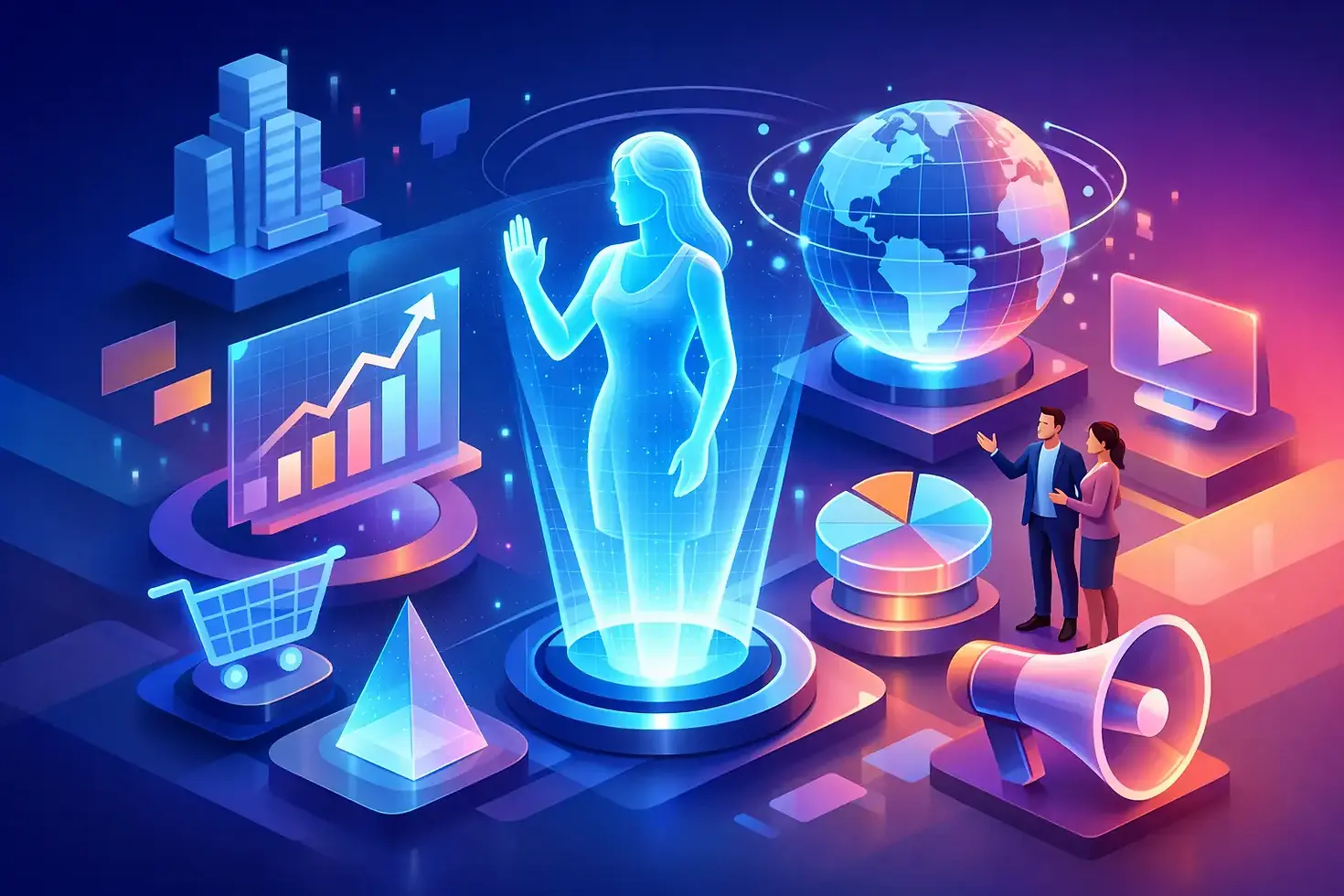
Hologram Marketing Trends for 2026 That Matter

A static display can be ignored in seconds. A bright, dimensional product visual floating above a booth, bar, stage, or storefront changes where people look - and often where they point their phones. That is why hologram marketing trends for 2026 are moving beyond novelty. Brands are using holographic displays to create real attention, stronger recall, and content people want to share.
The opportunity is not simply to add a futuristic screen to an event. The strongest activations make the hologram part of the campaign idea: a product reveal that stops traffic, a character that welcomes guests, or an animated visual that makes a compact footprint feel much bigger. For marketers and event planners, 2026 will reward experiences that look extraordinary while staying practical to install, operate, and measure.
Hologram Marketing Trends for 2026: What Is Changing
Bigger impact from modular hologram walls
One oversized centerpiece still has its place, especially for a product launch or main-stage moment. But modular holographic LED walls are becoming a more flexible choice for brands that need to fit different venues, floor plans, and budgets. A display can be scaled for a trade show booth, a retail window, a concert backdrop, or a multi-location campaign without rebuilding the entire concept from scratch.
This flexibility matters because event spaces rarely behave like a clean render. Ceiling heights, sightlines, lighting conditions, and guest flow all affect what will look best on site. A modular setup gives planners more room to position the experience where it will attract attention rather than force the event around the technology.
For campaigns with several stops, consistent visuals can travel while display size adapts to each location. That creates recognizable brand presence without making every activation feel identical.
Product storytelling replaces generic visual loops
In 2026, the best hologram content will look less like a random futuristic animation and more like a short visual story. A sneaker can assemble itself in midair. A beverage can burst into ingredients and color. A new vehicle feature can be shown in a clean, dramatic sequence that takes only a few seconds to understand.
The distinction is important. Motion alone earns a glance. Motion with a clear message gives that glance a purpose. For a crowded trade show floor, a holographic display should answer one immediate question: What is this brand showing me, and why should I care?
That does not mean every animation needs to explain every feature. In fact, trying to fit a full presentation into a looping display can dilute the effect. Strong content often focuses on one visual promise, one hero product, or one memorable transformation. Audio-enabled presentations can add context where the environment allows it, but the visuals should still communicate the core idea with the sound off.
Social capture becomes part of the floor plan
Shareability is no longer an extra benefit. It is a planning requirement. Guests instinctively film a convincing holographic effect, especially when the content appears to float, react, reveal, or transform. In 2026, brands will design more activations around the camera angle as carefully as the in-person view.
This means thinking about where people will stand, what appears behind the display, and how long the key visual moment lasts. If the payoff happens too quickly, guests miss it. If a loop runs too long, fewer people wait through it. A repeatable sequence of roughly 10 to 20 seconds often gives guests enough time to notice the display, pull out a phone, and record the reveal.
A simple prompt can help without feeling forced: “Watch the next reveal,” “Choose your color,” or “Catch it on camera.” The goal is not to turn every guest into an influencer. It is to create a moment worth documenting naturally.
Live holograms bring energy to programmed events
Pre-rendered content is reliable and visually polished, but live holograms are gaining momentum for events that need personality and immediacy. A remote executive can appear at a sales meeting. A performer can make a surprise entrance at a concert. A host can welcome attendees to a launch party in a format that feels more theatrical than a standard video feed.
Live moments work best when they are treated as programming, not background décor. They need a clear entrance, purposeful lighting, strong audio, and an audience that can gather around the reveal. A live hologram shown in a loud, open reception area may lose impact. The same appearance on a defined stage can become the moment people remember from the night.
There is a trade-off: live content requires more rehearsal and production coordination than a looping animation. For a short, high-stakes appearance, that planning is worth it. For all-day foot traffic, a polished loop may be the smarter and more dependable choice.
Personalized content makes premium feel personal
Brands have spent years talking about personalization. Holographic displays give that idea a more visible form. Instead of placing a guest’s name on a standard screen, a campaign can show a custom animation, selected product color, location-specific message, or celebratory visual designed around a participant’s choice.
For consumer events, this can turn a birthday, wedding, or VIP party into an experience with a true signature moment. For commercial activations, it can turn a product configurator into a lively visual interaction. A customer picks options, and the object appears to build itself in front of them.
Personalization should be fast and intuitive. If a guest needs to complete a long form before seeing the result, the experience becomes a task. The most effective executions keep the interaction light, then make the visual payoff feel immediate.
Brands are planning for the full environment
A holographic display can be the center of an activation, but it does not perform in isolation. Ambient light, display placement, nearby LEDs, sound, and traffic flow all shape the final effect. This is one of the most practical hologram marketing trends for 2026: better production planning before the equipment reaches the venue.
A bright outdoor-facing space may call for different placement than a dimmed ballroom. A retail installation needs content that works for people walking past quickly. A gala reveal needs room for guests to gather and a visual setup that supports the camera angles. The technology is accessible, but the experience still needs to be designed around the setting.
That is also why turnkey support matters. Event teams should not have to become display specialists to create something impressive. They need guidance on sizing, content format, installation timing, and how the hologram fits the run of show.
How to Turn a 2026 Trend Into a Campaign Win
Start with the moment you want people to remember. It may be the first sight of a new product, the second guests walk into a venue, or a timed reveal during a presentation. Once that moment is clear, choose the display scale and content style that support it.
Next, plan for two audiences at once: the people in the room and the people who will see the footage afterward. Give guests a clean viewing position and give cameras a strong visual frame. Avoid placing the display where cluttered signage, bright backlighting, or a bottleneck of people will weaken the effect.
Then keep the message disciplined. A hologram can show a lot, but more animation does not automatically create more impact. One product transformation, one bold visual, or one live appearance can carry a campaign farther than a crowded sequence of competing messages.
Finally, define what success looks like before the event. For one brand, it may be qualified leads. For another, it may be social posts, dwell time, press attention, or guest feedback. Holographic marketing is highly visual, but it should still support a business goal.
The brands that stand out in 2026 will not use holograms just because they look futuristic. They will use them to give people a reason to stop, feel something, and remember who created the moment. If your next event or activation needs that kind of attention, build the experience around one unforgettable visual idea - then give it the production support to deliver.


Comments