
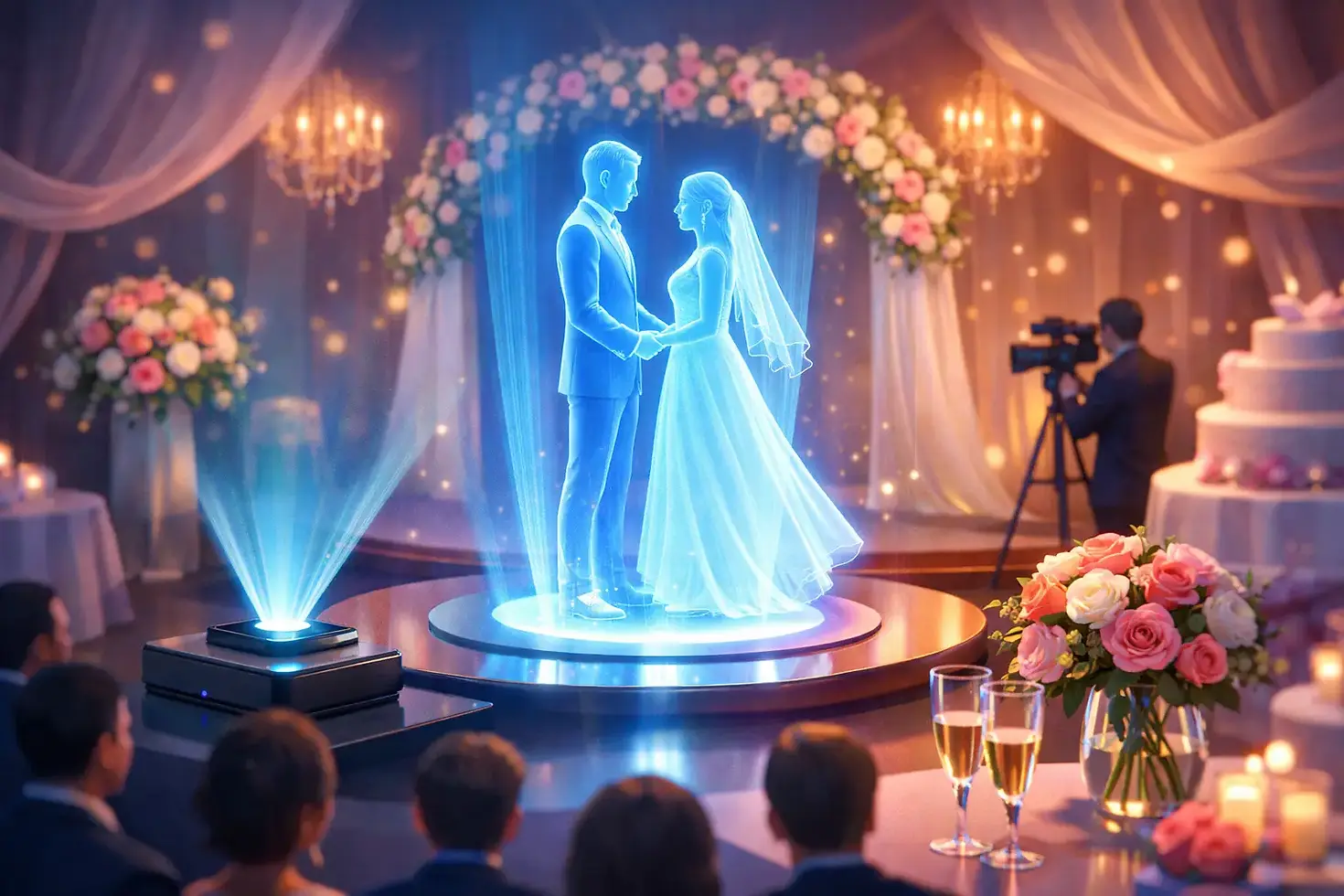
How to Use Holograms at Weddings

A wedding can have perfect flowers, great lighting, and a packed dance floor - and still feel familiar. Holograms change that. If you’re figuring out how to use holograms at weddings, the real opportunity is not just adding a cool effect. It’s creating moments guests talk about long after the last song.
The best hologram weddings do not feel like a tech demo. They feel personal, cinematic, and surprisingly natural inside the celebration. When the visuals are matched to the couple, the venue, and the flow of the night, holograms become more than entertainment. They become part of the experience.
How to use holograms at weddings without overdoing it
The smartest approach is to choose one to three high-impact moments instead of trying to place holograms everywhere. Weddings already have a lot competing for attention - florals, signage, music, catering, photography, and guest movement. A hologram works best when it has room to land.
For some couples, that means using a holographic display at the entrance so guests get the wow factor right away. For others, it works better during cocktail hour, near the dance floor, or as part of a reception reveal. The key is intention. A hologram should support the event design, not distract from it.
This is where planning matters. You want to think about sightlines, ambient light, power access, and where guests naturally gather. A beautiful installation in the wrong corner will not have the same impact as a well-placed display integrated into the event layout.
Where holograms work best during a wedding
Guest arrival is one of the strongest placements. A holographic welcome message, floating monogram, animated floral graphic, or rotating couple logo instantly sets a different tone. It tells people this is not going to be a standard ballroom evening.
Cocktail hour is another natural fit because guests are moving, mingling, and taking photos. This is a great time for looping visuals, custom 3D animation, or short branded-style sequences built around the couple’s story. Think engagement photos reimagined in motion, animated initials, or a visual motif pulled from the invitation suite.
At the reception, holograms can elevate key transitions. A grand entrance becomes bigger when digital visuals build anticipation before the couple walks in. A first dance feels more immersive when the display supports the mood instead of overpowering it. Even a cake-cutting moment can feel more theatrical with softly animated visuals nearby.
Some couples also use holograms for memory-driven content. That might be a tribute to family members, a visual timeline of the relationship, or a stylized pre-recorded message. This can be incredibly moving, but tone matters. If the content is emotional, the display design should be restrained and elegant rather than flashy.
The most effective hologram wedding ideas
The most successful concepts usually combine spectacle with meaning. A floating “Welcome to Our Forever” graphic may get attention, but custom content tied to the couple gets remembered.
One strong use case is a holographic seating chart or directional display near the reception entrance. It is practical, but it also turns a usually static element into something guests want to film. Another is a holographic photo moment. Instead of a standard backdrop, you create a visual installation that feels interactive and premium, especially if the content loops cleanly for social sharing.
Live-style appearances can also work, but they depend on the wedding style and budget. If a couple wants a highly produced reveal, a hologram can present a custom intro, an animated story sequence, or a special message before they enter. This works particularly well for modern luxury weddings, multicultural celebrations, and high-energy receptions where production value is already part of the vision.
There is also a place for subtlety. Not every wedding needs a giant futuristic statement. Some of the best executions are elegant and controlled - floating candle-like visuals, delicate botanical motion graphics, or a softly rotating monogram integrated into a black-tie setting.
Match the hologram to the wedding style
A hologram should fit the wedding, not fight it. That sounds obvious, but it is where many event add-ons fall apart.
For a modern city wedding, sharper graphics, cleaner motion, and bold visual reveals usually make sense. For a romantic garden celebration, the content should lean softer, lighter, and more organic. For a luxury ballroom event, the display can feel polished and dramatic, but still needs restraint so it complements the room instead of competing with it.
This is also why custom content matters. Generic visuals can look impressive for a minute, but they rarely feel personal. Tailored animation, couple branding, color matching, and audio integration help the hologram belong in the wedding rather than sit beside it.
If you are working with a planner or designer, involve the hologram vendor early. It is much easier to coordinate content with florals, staging, signage, and lighting before everything is locked in.
Budget, logistics, and what couples often miss
When people first look into holograms for weddings, they usually ask about price. That makes sense, but the better question is what kind of moment you want to create.
A single display with looping visuals at cocktail hour is a very different investment from a larger multi-display setup with custom animation and audio-timed content. Rentals are often the right fit for one-time wedding use, especially when the goal is a signature moment rather than an all-night installation.
The biggest planning mistake is leaving holograms until the final weeks. Custom visuals take coordination. So does placement. Your venue may have restrictions related to load-in timing, power, staging, or where equipment can sit without interrupting service.
Lighting is another factor. Holographic displays can perform beautifully in event environments, but placement still affects visibility. A vendor should help evaluate whether the display is best near an entrance, against a darker backdrop, or away from intense direct light. It depends on the room and the time of day.
You will also want to think about guest flow. If the hologram is designed as a photo moment, there should be enough space for people to gather without creating a bottleneck. If it is part of a reveal, guests need a clean line of sight. Good execution is not just about the screen. It is about the full environment around it.
Working with a hologram vendor
If you want to know how to use holograms at weddings successfully, the answer often comes down to the partner you choose. You do not need to become an expert in display technology. You need a team that can translate your ideas into something visually powerful and operationally smooth.
A good vendor will ask about the venue, event timeline, audience size, wedding style, and content goals before recommending a setup. They should also be clear about what is custom, what is standard, and how installation works on the day of the event.
Look for support beyond the hardware. The strongest results come from providers that can help with motion graphics, sizing, content formatting, and on-site execution. That is especially valuable for couples and planners who want a polished result without managing technical details themselves.
At VX Holo, that is the point of the experience: making holographic displays feel exciting and accessible, not complicated. For weddings, that means building something memorable while keeping the process collaborative and manageable.
When holograms make sense - and when they do not
Holograms are a strong fit for couples who want a wedding that feels current, visual, and highly memorable. They work especially well when the event already has a design-forward approach and guests are likely to engage, film, and share standout moments.
They may be less essential for a very intimate wedding where the focus is entirely on simplicity and minimal production. That does not mean they cannot work in smaller settings. It just means the concept should be scaled appropriately. A refined welcome installation may fit beautifully, while a larger showpiece could feel out of place.
The goal is not to force futuristic technology into every wedding. The goal is to use it where it adds emotion, energy, or atmosphere in a way traditional décor cannot.
A great wedding detail does more than look expensive or trendy. It gives people a feeling. Holograms do that best when they are thoughtful, personal, and timed to the right moment. If you treat them as part of the storytelling instead of just a novelty, they can turn a beautiful wedding into one guests genuinely have never seen before.


Comments